New START ratification: “not a bipartisan but a non-partisan challenge…”

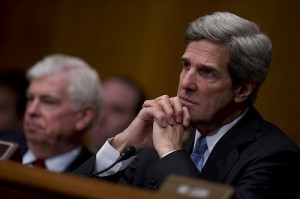
Sen. John Kerry, chairman, Senate Foreign Relations Committee listens to New START testimony on May 18, 2010. (DoD photo by Mass Communication Specialist Chad J. McNeeley/Released). Click for more information.

Last month, the US Senate Committee on Foreign Relations (SFRC) began a series of hearings on the New Strategic Arms Reduction Treaty, which Presidents Obama and Medevedev signed at the beginning of April. I’ve written extensively about the treaty, which is an agreement between the United States and Russia that was first signed in 1991. It has to be evaluated periodically, setting new goals for post-Cold War reductions of our respective strategic nuclear arsenals. Each country’s legislative bodies have to ratify the treaty, which is what has been one of the big topics of discussion in arms control circles this spring.

Of course, there are difficulties to overcome in the US Senate regarding ratification of the treaty; I’ve discussed this on several occasions, as have a number of other people. We’re all tentatively predicting ratification of the treaty, though probably with less votes than it has been ratified in the past.

What’s been going on at the SFRC hearings is what I’d like to focus on today, however. The testimony has come from an impressive line-up of people with extensive history in the arms control arena. They’ve presented solid, convincing testimony regarding why the treaty must be ratified, and why not ratifying the treaty, or delaying ratification, is not in the interest of national or even global security.

Although those who have voiced concerns about the treaty have all been Republicans, the running theme in all of the testimony has not been “bipartisanship”. As Henry Kissinger said (pdf) in the May 25, 2010 hearing, the issue of New START ratification is, quite simply:

This Committee’s decision will affect the prospects for peace for a decade or more. It is, by definition, not a bipartisan but a non-partisan challenge.

In other words, national security issues like arms control treaties should transcend partisan concerns and should not be politicized. The discussion should be about whether or not the details of the New START treaty are in the best interest of our national security, and are truly representative of a move away from Cold War thinking and into the twenty-first century.

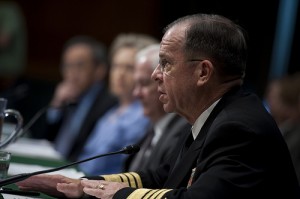
This is what brings us to last week’s hearing. The media reports are few, but what they’ve mostly emphasized is that the SFRC will vote on New START before August, and therefore send the treaty to the Senate floor before the Senate goes on its August break (see The Hill blog and the Agence-France Press.)

That’s definitely a story worth reporting, but what I think is more noteworthy is something very specific that was said in the hearing.

Read More »

Posted in New START, Nuclear Weapons | Tagged , , , , | Leave a comment

Nuclear Follies: How Not To Stem the BP Oil Gusher

Also published here.

Over the past few years, as I've written about various aspects of nuclear weapons and nuclear non-proliferation issues, I've observed one particularly disturbing trend, which is the rather cavalier attitude people have toward “nukes”. I'm not a sociologist, and I haven't conducted a formal study, but there's a tendency among people online and offline to say “just use a nuke”. Or, “why can't they nuke 'em?”, as if nuclear weapons were shotguns, and the use of one wouldn't have catastrophic global consequences.

Never has it been more apparent that there's a lot of misunderstanding (deliberate or otherwise) regarding nuclear weapons than recently. I'm talking about the appalling, misguided idea that we can “just nuke” the BP oil gusher and it will some how “be okay”.

Here's the Global Security Newswire's “Quote of the Day” from June 3, 2010:

Drill a hole, drop a nuke in and seal up the well.

–CNN reporter John Roberts, discussing one suggestion for dealing with the underwater oil leak in the Gulf of Mexico. The Obama administration has rejected the idea.

Then there was an NPR article from June 4, 2010 entitled:

Stopping A Spill? There's Always The Nuclear Option

Even Mother Jones mentioned it as a possibility, though it was more tongue-in-cheek than some of the other articles out there.

Okay, guys, I'm going to say it slowly, loudly, and clearly:

The use of a nuclear weapon to stop the BP oil gusher is not an option. It is, in fact, the worst possible thing we could do. Here's why.

Geopolitical Implications: Let's Cause An International Incident!

Way back in 1963, after almost two decades of nuclear testing, the United States and the former USSR were the first of a large number of countries who signed the Limited Test Ban Treaty, also know as the Partial Test Ban Treaty:

The Test Ban Treaty of 1963 prohibits nuclear weapons tests “or any other nuclear explosion” in the atmosphere, in outer space, and under water. While not banning tests underground, the Treaty does prohibit nuclear explosions in this environment if they cause “radioactive debris to be present outside the territorial limits of the State under whose jurisdiction or control” the explosions were conducted. In accepting limitations on testing, the nuclear powers accepted as a common goal “an end to the contamination of man's environment by radioactive substances.”

Read More »

Posted in Nuclear Weapons | Tagged , , , , | 1 Comment

Going Rogue: Can You Build Your Own Nuclear Arsenal?

So you think you're smart, huh? Maybe even sneaky? Could you easily build your own nuclear arsenal without anyone finding out? Test your cleverness with the Stimson Center's new online game, Cheater's Risk. The background is fascinating:

As part of Stimson's “Unblocking the Road to Zero” project, which seeks to advance the debate about negotiated nuclear disarmament as a viable and practical policy option, Alex Bollfrass and Barry Blechman have developed Cheater's Risk,  an online game that explores the dynamics of a world without nuclear weapons. Players take on the challenge of breaking out of a hypothetical disarmament regime without being detected by national intelligence services and international monitors. Depending on which country is selected, different pathways to the bomb are available. As the player navigates the pathways, the cumulative odds of detection are calculated.  At the end, famed weapons inspector Hans Blix determines if the player has gotten away with it or has been caught.  The game is founded upon empirical research, published in Elements of a Nuclear Disarmament Treaty, an edited volume showing how to overcome technical obstacles to disarmament.

When I played the game as the Netherlands, I managed to amass 1-5 nukes, but it was by sheer luck that I didn't get discovered while I acquired all the materials.

Watch the trailer:

Cheater's Risk Trailer from Henry L. Stimson Center on Vimeo.

Check out the game. Are you feeling lucky?

Posted in Nuclear Weapons | Tagged , , | Leave a comment